
Arise! let our banner be flung to the skies!
See the northern battalions are roused to the fight.
The echoing mountains shall wake to our cries;
Our country and liberty! God and the right!
The Second Infantry was recruited and enlisted for the Civil War, under the first proclamation of President Lincoln, of April 15, 1861, calling for 75,000 volunteers of the organized militia of the loyal States, for three months service, from the following organized militia companies of this State, and was called into service as a three months’ regiment, and was rendezvoused as such under the following order; but on subsequent instructions from the War Department, it was reorganized and re-enlisted for three years, allowing those who did not desire to enter the service for that term to withdraw, and the members of companies who remained were recognized as in the service of the State from the date of the order referred to until mustered into the service of the United States, and were paid by the State accordingly:
Military Department, Michigan.
Adjutant General’s Office.
Detroit. Mich., April 25th, 1861.GENERAL ORDER NO. 6.
- The Second Regiment, Michigan Infantry, is now formed, and the following officers are hereby appointed: Israel B. Richardson, to be colonel; Henry L. Chipman, to be lieutenant colonel; A. W. Williams, to be major.
- The following companies will constitute the regiment, viz.: Detroit Scott Guard, Adrian Guard, Hudson Artillery (as infantry), Flint Union Guard. Battle Creek Artillery (as infantry), Constantine Union Guard, East Saginaw Guard, Kalamazoo Light Guard, Kalamazoo No. 2, Niles Company.
- The captains of these companies will report forthwith by letter to their colonel, at Detroit, and await his orders before moving.
- The colonel will, in orders, designate the letters of companies and the rank of the captains respectively, and complete the organization.
By order of the Commander-in-Chief,
JNO. ROBERTSON.
Adjutant General.
With the exception of the Kalamazoo (No. 2) and Niles, the regiment was made up of the uniformed militia companies, and all were recruited and organized at the places named.
On the receipt of his appointment, Colonel Richardson promptly issued the following order:
Headquarters Second Regiment Michigan Infantry,
Detroit, April 26th, 1861.BATTALION ORDER NO. 1.
- Quarters for the accommodation of this regiment being now in preparation for its reception, its different companies will commence their movements upon this place on Tuesday next, under direction of their respective captains.
- Each company will so arrange Its movements as to arrive in this city during the day time, the captain reporting in person to the colonel, who will designate the position of each to occupy in “line of battle.”
- (IV)The quarters at the Agricultural Fair Grounds to be occupied by the regiment will hereafter be known under the name of Cantonment Blair.
I. B. RICHARDSON.
Colonel Second Michigan Infantry.
The companies assigned to this regiment had been anxiously awaiting at their respective locations for acceptance into service, and on the receipt of the order of the 25th to rendezvous at Detroit, with remarkable promptness immediately commenced their movement, and all were in camp on the evening of the 27th, much to the surprise of the Colonel, who had expected that some days would elapse before they would reach camp, and as a consequence the quarters were not in good condition for their reception.
Extract from Colonel Richardson’s Battalion Order No. 4, dated at Cantonment Blair, May 1, 1861:
The different companies composing this regiment will take their positions in line of battle from right to left In the following order, and will be known hereafter by the annexed letters:
Scott Guard, known as Company A.
Hudson Artillery, known as Company B.
Battle Creek Artillery, known as Company C.
Adrian Guard, known as Company D.
Niles (Color Company), known as Company E.
Flint Union Greys, known as Company F.
Constantine Union Guard, known as Company G.
East Saginaw Guard, known as Company H.
Kalamazoo Light Guard No. 1, known as Company I.
Kalamazoo Blair Guard No. 2, known as Company K.
While in process of organization the regiment was transferred to Fort Wayne, near Detroit, where its recruitment was completed, being mustered into the service of the United States May 25, 1861, with 1,013 officers and men on its rolls, being the first of the three years’ regiments raised in the State.
FIELD AND STAFF.
Colonel, Israel B. Richardson (formerly of the Regular Army), Pontiac. Lieutenant Colonel, Henry L. Chipman, Detroit. Major, Adolphus W. Williams, Lansing. Surgeon, Alonzo B. .Palmer, Ann Arbor. Assistant Surgeon, Henry F. Lyster, Detroit. Adjutant, William J. Lyster, Detroit. Quartermaster, _____. Chaplain, ______.
- Captain, Louis Dillman, Detroit. First Lieutenant, John V. Ruehle, Jr., Detroit. Second Lieutenant, Gustave Kast, Detroit.
- Captain, Reuben A. Beach, Hudson. First Lieutenant, Cyrus E. Bigelow, Hudson. Second Lieutenant, Tilson C. Barden, Hudson.
- Captain, Cornelius Byington, Battle Creek. First Lieutenant, Joseph M. Barton, Battle Creek. Second Lieutenant, Joseph F. Gilman, Battle Creek.
- Captain, William Humphrey, Adrian. First Lieutenant, Frank M. Wood, Adrian. Second Lieutenant, William L. Burlingame, Adrian.
- Captain, Robert Brethschneider, Niles. First Lieutenant, Benjamin Brownell, Niles. Second Lieutenant, Jerome Beals, Niles.
- Captain, William R. Morse, Flint. First Lieutenant, William Turver, Flint. Second Lieutenant, James Farrand, Flint.
- Captain, John A. Lawson, Constantine. First Lieutenant, Richard T. Morton, Constantine. Second Lieutenant, William J. Lyster, Detroit.
- Captain, William L. Whipple, Detroit. First Lieutenant, Emil Moores, Detroit. Second Lieutenant, John Leidlin, Saginaw.
- Captain, Dwight May, Kalamazoo. First Lieutenant, William J. Handy, Kalamazoo. Second Lieutenant, John M. Norvell, Detroit.
- Captain, Charles S. May, Kalamazoo. First Lieutenant, George W. Park, Kalamazoo. Second Lieutenant, Harry C. Church, Kalamazoo.
The regiment moved from its rendezvous at Fort Wayne, June 6th, for the field in Virginia, arriving in Washington on June i10th, and a few days later took up its quarters at Camp Winfield Scott, on Washington Heights, near “Chain Bridge.”
The ladies of Niles gave a National color of silk to Company E before it left that city to join the regiment in Detroit, which afterward became the regimental color. It was carried by the regiment through all its hard fought battles up to and including Fredericksburg, when it had become so tattered by wear, and by some forty bullet holes, that it was deemed unserviceable, and was returned to the donors, who treasure it highly. It possesses a gallant record, having come out gloriously from every engagement, while eleven of its upholders or defenders were either killed or wounded.
Its first engagement was at Blackburn’s Ford, Va., July 18, 1861, with a small loss in wounded, serving in General Tyler’s Division. Colonel Richardson being in command of the brigade and Lieutenant Colonel Chipman having been appointed a captain in the Regular Army, the command of the regiment devolved upon Major Williams. In Lossing is found the following:
Toward noon Tyler went out on a reconnaissance toward Blackburn’s Ford, taking with him Richardson’s Brigade, a squadron of cavalry, and Ayres’s battery, and holding Sherman’s brigade in reserve. He found the Confederates In heavy force. Beauregard, who had been informed of all of McDowell’s movements by spies and traitors, was there, and had ordered up from Manassas some North Carolina and Louisiana troops, who had Just arrived there on their way to Winchester. The woods were so thick that his forces were’ mostly concealed, as well as his batteries, excepting one on an open elevation. Hoping to draw their fire and discover their position, Ayres’s battery was placed on a commanding eminence, and a 20-pound cannon, under Lieutenant Edwards, was fired at random. Only the battery in view responded, and grapeshot from it killed two cavalry horses and wounded two men. Richardson now sent forward the Second Michigan regiment as skirmishers. They were soon engaged in a severe contest in the woods, on a level bottom near the Run. The Third Michigan, First Massachusetts, and Twelfth New York were pushed forward to support the advance, and these, too, were soon fighting severely.”
General Tyler, commanding the troops at Blackburn’s Ford, says in his report of the affair:
“… Having satisfied myself that the enemy was in force, and also as to the position of his batteries, I ordered Colonel Richardson to withdraw his brigade, which was skillfully but unwillingly accomplished, as he requested permission with the 1st Massachusetts and Second and Third Michigan regiments to charge the enemy and drive him out. It is but justice to these regiments to say that they stood firm, maneuvered well, and I have no doubt would have backed up manfully the proposition of their gallant commander.”
The regiment, although not actually engaged at Bull Run, had the honor, together with the Third Michigan, of covering the retreat from that disastrous field.
The correspondent of the New York Tribune, in writing regarding the stampede from Bull Run, says:
“I was told that a few regiments, beside the three faithful ones of Blenker’s Brigade, had come in in fair order, and that they were the Second and Third Michigan, and the Massachusetts First, of Richardson’s brigade. I should be glad if it were so.”
The following is a report of Colonel Richardson on the subject, made to General McDowell, through his Assistant Adjutant General:
Department N. E. Virginia,
Headquarters Fourth Brigade.
August 11th, 1861.Captain:—Permit me to correct an unintentional error that has crept into Brigadier General McDowell’s official report of the engagement of July 21st.
By command of Brigadier General McDowell, given me in presence of Colonel Jackson, Eighteenth New York Volunteers, and of Captain Whipple of the Engineer Corps, to conduct the retreat, and to cover the retreat with my brigade, I did so cover the retreat from Centreville. I brought up the rear with my brigade in the following order: Twelfth New York leading, followed by First Massachusetts; the Third Michigan taking up position, kept in rear, and followed by the Second Michigan. About one mile this side of Centreville we were obliged to halt on account of other regiments, and the Second Michigan then took the position of the Third Michigan, and thus marching in good order we reached Arlington about 4 o’clock p. m. on Monday, the 22d, and went into camp, having moved in rear of all other regiments and batteries. At Fairfax we were so far in rear that no troops (of our own forces) were in sight. Will you do my Brigade the credit of this correction.
I. B. RICHARDSON,
ColonelCAPTAIN JAMES B. FRY,
Assistant Adjutant General, Arlington.
Lossing is good authority on this point, and says:
“Leaving the sick, and wounded, and dying, who could not be removed, under proper caretakers in a stone church at Centreville (which was used a long time as a hospital), the army moved forward at a little past ten o’clock, with Colonel Richardson’s Brigade as a rear-guard. Most of them reached the camps near Washington, which they had left in high spirits on the 16th, before daylight. Richardson left Centreville at two o’clock in the morning, when all other troops and batteries had retired, and twelve hours afterward he was with his brigade on Arlington Hights.”
During the winter the regiment lay near Alexandria, and in March, in command of Colonel Orlando M. Poe, Lieutenant of the U. S. Engineer Corps, who had been commissioned Colonel, September 16, 1861, in place of Richardson appointed Brigadier General, entered on the Peninsular campaign under General McClellan, serving in Berry’s Brigade, Kearny’s Division, Heintzelman’s Corps, being the Third Brigade, Third Division, Third Corps, and took part in the siege of Yorktown, and was in the engagements following: At Williamsburg, May 5th; at Fair Oaks, May 31st; near Richmond, June 18; at White Oak Swamp, June 29; at Charles City Cross Roads, June 30th and on July 1st at Malvern Hill; its casualties at Williamsburg being seventeen killed, thirty-eight wounded and five missing; at Fair Oaks, ten killed and forty-seven wounded, and in the actions of June 18th to July 1st, two killed and nineteen wounded.
At Williamsburg the regiment was in immediate command of Colonel Poe, with Lieutenant Colonel Williams commanding on the right, and Major Dillman on the left. Report of Colonel Poe:
To Captain Sturgis, A. A. A. G., Kearney’s Division:
Sir: In conformity with instructions from Division headquarters, I have the honor to submit the following report of the part taken by the Second Michigan Volunteers in the action of Monday, the 5th instant, in front of Williamsburg:
After an excessively fatiguing march, the last three miles of which we made without knapsacks, the regiment reached the scene of action about 2 o’clock p. m. I had previously received instructions from the General commanding the division as to the disposition I was to make of the regiment, which without halting went into action, two companies to the right and two companies to the left of the road, six companies being held in reserve. At about 3.30 to 4 p. m. one more company was thrown from the reserve to the right of the road and another to the left. It was at this time, and while giving Captain Morse his instructions, that he fell severely wounded. At about 6 p. m. the companies which had been actively engaged from the first, grew short of ammunition, when I threw forward the four companies of the reserve which had not been engaged. These four companies did not leave their ground until finally ordered to do so.
I must express in the highest terms my satisfaction with the conduct of both officers and men. They acted under the eye of the General commanding the division and never once failed to respond to his directions.
When the conduct of all was so good it is perhaps invidious to attempt to distinguish any, yet I feel compelled to speak of the cool and daring conduct of Lieutenant Dobson (wounded) and Wallace (killed). The latter refused to leave the ground after being once wounded, and remained, doing excellent service until a ball through his head killed him. There are plenty of others who deserve the same commendation, but I only speak of what came under my own notice.
I ought perhaps to speak of Private Allen, who was a new recruit, never having had a musket until the day before; he was found dead beside a dead foe, each transfixed by the other’s bayonet.
The regiment took into action three hundred. The loss is as follows: Killed, 17; wounded, 38: missing, 5, supposed to be prisoners; total. 60. During the action Lieutenant Colonel Williams commanded upon the right of the road, Major Dillman upon the left, while I exercised in person general supervision over the whole line.
Very respectfully, O. M. POE.
Colonel Second Michigan Volunteers.
Lossing says:
“Hooker had repeatedly called on Sumner for help, but could get none, for that officer had ordered a large portion of the troops In hand to the right, under Hancock, to keep the Confederates In check In that direction, and to flank the works if possible. So he fought on, maintaining his ground until between 4 and 5 o’clock, when the gallant and dashing Philip Kearny came up with his division, with orders from Heintzelman (who with his staff had arrived early in the afternoon) to relieve Hooker’s worn and fearfully thinned regiments. Kearny pressed to the front and Hooker’s troops withdrew from the fight and rested as a reserve.
“Kearny deployed Berry’s Brigade to the left of the Williamsburg road, and Birney’s to the right, and at the same time two companies of Poe’s Second Michigan were pressed forward to cover the movement and drive back Confederate skirmishers, who were almost silencing the National batteries.
“The battle, which was lagging when Kearny arrived, was renewed with spirit, and the Nationals began to slowly push back their foe.”
Extracts from correspondence of the New York Tribune in relation to the regiment at the battle of Williamsburg:
“The regiment was in the hottest of the fight. By the confession of prisoners, 800 of Berry’s men (mostly Michigan), drove back at the point of the bayonet 1,600 rebels.
“There were four companies of the Second Michigan heavily engaged at Williamsburg, two in command of Captain William Humphrey and two commanded by Captain W. J. Handy. The other companies of the regiment were partially engaged. The regiment lost in the action seventeen killed, thirty-eight wounded, and four missing.”
The following is the official order relative to the part taken at Williamsburg by Berry’s brigade, composed of the Second, Third and Fifth Michigan:
Headquarters Third Brigade, Kearny’s Division,
On Williamsburg Battlefield, May 8. 1862.Special Orders.
The Commander of the Brigade takes great pleasure in making this official communication to his command: That they, by heroic fortitude, on Monday last, by making a forced march through mud and rain, each vying with the other to see who could most cheerfully stand the hardships the time called for, making thereby a march that others shrank from, coming Into a fight at double-quick, made doubtful to our side by the overwhelming mass of the enemy poured upon our center; by a rapid deploy and quick formation, and by coolness, precision, and energy, beat back the enemy, recapturing our lost position and artillery, and also by a heroic charge took a stronghold of the enemy, and thereby dislodged him and drove him on the plain below his well-chosen position, have done themselves great honor, have honored the States of Michigan and New York, and have won a name In history that the most ambitious might be proud of.
Our loss of brave comrades has Indeed been large. We mourn the departed. “Green be the turf above them.” They have a place In our heart’s memory, and In the history of our common country.
Soldiers! you have won by your bravery the hearts of all your commanders— brigade, division, corps, and even those higher In command.
Soldiers, I thank you; my superiors thank you; your country thanks you, and will remember you In history.
Our labors are not yet over; the Insolent rebels that have endeavored to destroy, and have laid to ruin and waste portions of the best government and the finest land of earth, are still in force, and to be conquered In our fights. I have pledged you, men of the Third Brigade, in all future trials. I know my men; they are not pledged in vain.
Commanders of regiments will have this order read at the head of their respective regiments this afternoon.
R. G. BERRY.
Brigadier General, Commanding Third Brigade.
Official: EDWIN M. SMITH, A. A. A. G.
Letter from General Kearny to the commanding general.
Headquarters Third Division,
Camp Berry,
Barkamsville, Va., May 10th, 1862.Sir: The events which crowded on us after the battle of the 5th, its stormy night, the care of the wounded, the attention to the slain, the collection of the trophies, the moves of the next day, having prevented my report embracing the distinguished acts, of Individuals, not serving in my actual presence. Induced me to request that the superior authority of the Commander of the Corps would be employed to use, as my own, the separate report of those, my Brigade Commanders, who so nobly sustained my effort by their gallantry; and who amply fulfilled the high prestige which they had won as Colonels of noble regiments.
The battle on the left of the line was a series of assaults by the enemy, and repulses and onsets by ourselves, the fresh reinforcements of the enemy continually tending to outflank us. General Berry was ever on the alert, and by good arrangements and personal example Influenced the ardor of all around him. His regiments fought most desperately. It was one of them. Colonel Poe’s Second Michigan, more directly under my control, which maintained the key point of our position. Two of its companies led oft with the first success of the day, while covering the artillery.
Colonel Poe had already won a reputation in Western Virginia. He was a distinguished officer of the U. S. Army before taking command of this regiment. I especially notice him for advancement. His loss in killed, wounded and missing is sixty.
The principal loss on the left, of the two regiments (the fourth of the brigade). Third Michigan Volunteers, Colonel Champlin, serving immediately under the eye of General Berry, was very severe. The loss was ninety-six.
Colonel Terry, commanding the Fifth Michigan, was principally engaged In carrying rifle pits (a redoubt) in the woods. His loss is the highest on the list of killed and wounded, being 154.
I have the honor to be.
Very respectfully,
PHILIP KEARNY,
Brigadier General.
At Fair Oaks, the Second, still in command of Colonel Poe, is conspicuously marked for bravery. The press of the day says:
“Meantime Heintzelman sends forward Kearny to recover Casey’s lost ground. A desperate fight is going on at the extreme left. The enemy Is successfully held in front of Couch’s old intrenched camp until Kearny’s Division arrives, when he stays the torrent of battle. One after another his gallant regiments push forward, and press back the fiery rebels, with more daring than their own. The Fifty-fifth New York wins new laurels, and Poe’s Second Michigan is bathed in blood; 500 of them charge across the open field against ten times their number, stopping them in mid-career, losing seventeen brave fellows in that one desperate essay.”
The following is taken from the original in General Kearny’s handwriting, in the possession of Colonel Dillman, then Major of the Second Michigan, to whom it was sent on the second day of the battle of Fair Oaks:
June 1st, 4.20 p. m., 1862.
Major: I have just received your last bulletin. I will forward it for General McClellan. You have added new laurels to your past distinction and shall have full credit for these days.
Your friend, KEARNY,
Brigadier General.
After Fair Oaks Major Dillman assumed command, Colonel Poe and Lieutenant Colonel Williams being on leave of absence.
Following are extracts from a report of Captain William Humphrey covering the movements of the regiment from June 29th to July 3d, and including the engagements at Jordan’s Ford, Charles City Cross Roads and Malvern Hill:
“In pursuance of orders from brigade headquarters the Second Regiment Michigan Volunteer Infantry under command of Major Dillman took up its line of march from Camp Lincoln early in the morning of June 29th, marching to the rear of the camp, down the saw mill road until we reached an open field that had been occupied by General Couch’s Division as a camping ground.
“Here the regiment was halted. Two companies, E and H, were then thrown forward to a light breastwork at the edge of the woods, and covering the road down which we had marched from our camp. Three companies were sent back to the saw mill to act as vedettes on the roads leading from our old camp to the position we then occupied, also to throw out scouts to watch the movements of the enemy.
“The other five companies were held in reserve. About 2 p. m., the companies C, F, and K, at the saw mill, were ordered to draw in their vedettes and scouts, and Join the regiment, which In turn was ordered to join the brigade, then stationed behind the earthworks to the rear of us.
“As soon as these orders were executed the regiment moved on the road towards Jordan’s Ford, but before reaching the forks of the road where Kearny’s and Hooker’s Divisions were to separate, the artillery broke the column, dividing the regiment, four companies, A, B, D, and G, taking the road to the right toward the ford, which they crossed about 4 p. m.. and were soon after engaged In a warm skirmish with the enemy’s pickets, who were found pretty strongly to dispute the passage of another ford (name not known) beyond Jordan’s. It was soon deemed impracticable to attempt to force a passage, and the troops were ordered to recross Jordon’s Ford. The companies of the Second Regiment, A, B, D, and G. were ordered to hold the enemy in check until the recrossing of the ford was accomplished by the rest of the troops, when they were to fall back and bring up in the rear of the division, which order was fully executed.
“The other six companies took the road to the left, followed it as far as the saw mill in front of Crittenden’s Ford, when finding they were on the wrong road, they retraced their steps, took the road toward Jordan’s Ford and reached it Just as the division was recrossing. They at once Joined the column and marched with it across and some two miles beyond Bracket’s Ford and encamped for the night.
“June 30th.—This morning the companies of the regiment reunited, and the regiment joined the brigade, and all were marched to a position some distance to the front of where we had encamped for the night. Soon after we changed our position to the left and rear, on to the expected battlefield, and at once formed in column of division, to the right of the open field; soon we were ordered to a position further to the right. From here we marched to the front, and were placed in position to support the Twentieth Indiana Regiment, who were holding a slightly constructed rifle pit, formed by hurriedly throwing together loose rails. We joined the Twentieth Indiana in the pit about 3 p. m., and with them held it under a galling fire from our front and left flank until the battle ended.
“As soon as the firing ceased and the enemy had drawn from the field, we received orders to throw out pickets in front of the rifle pit to observe the movements of the enemy. The line was at once formed and a sharp lookout kept by all, for the enemy was observed to be on the alert, and about midnight quite a force was seen filing along their lines toward our right. From the number of colors seen this force consisted of at least twelve regiments.
“From their cries for their comrades, we ascertained that the wounded from at least twenty-four of the enemy’s regiments lay on the battle-field within talking distance of our position.
“July 1st.—At 2 a. m. we were ordered to call in our pickets and march at once. We were soon on the road and about 5 a. m. reached Haxall’s Landing on the James river. After a short rest we were marched up to the right and front of the line, then being formed to meet a threatened attack of the enemy. On reaching the ground we, with the rest of the brigade, were placed in position to support our batteries, that were now playing on the enemy’s advancing columns, or replying to a fierce fire from his batteries.
“We reached this position about 9 a. m. and remained here until 12 m. During the whole of this time the shot and shell from the enemy’s guns were incessantly flying over our heads and through our ranks. At 12 m. we were drawn back under shelter of the hill, where we remained until again ordered to march.
“July 2d.—A little past midnight and we were again marching and taking the road down the river, reaching the camp (Harrison’s Landing) of the army about 9 a. m.
“I omitted to mention in the proper connection that Major Dillman was carried to the rear at 12 m., July 1st. He was obliged to go, from the excessive labor and fatigue of the last few days.
“By order of Brigadier General Berry I at once assumed command of the regiment.”
The regiment remained at Harrison’s Landing until August 15th, when, in command of Colonel Poe, it took up the line of march via Charles City in the direction of Williamsburg, reaching there on the 18th. On the 19th marched to Yorktown, and next day embarked on a steamer for Alexandria, reaching there on the 21st, and on the 23d took a train for Warrenton Junction, from whence it marched to Manassas, arriving there on the 28th at noon. At 3 p. m. left for Centerville, and at Blackburn’s Ford met and engaged the enemy’s cavalry, repulsing them and reaching Centerville at 6 p. m. On the 29th the regiment, in command of Lieutenant Colonel Dillman, Colonel Poe being in command of the brigade, continued the the march, and crossing Bull Run moved to the front, deployed as skirmishers, and on recrossing Bull Run soon discovered the enemy in force, when he opened a heavy fire with shell and shrapnell from a number of batteries. Soon the regiment was withdrawn across the stream under a heavy fire from the batteries. On the 30th, again deployed as skirmishers, moving down the stream by the right flank, and recrossing it withdrew from the field; became engaged in protecting the flank and rear of the brigade from the numerous assaults of the enemy’s cavalry, and although several furious charges were made they were gallantly repulsed and the march resumed, reaching Centerville about 11 p. m.
On September 1st the regiment, with its brigade, broke camp at Centerville, marching in the direction of Fairfax Court House, and when about three miles out met the enemy at Chantilly, at 4 p. m., when a severe and bloody engagement took place, continuing until dark, which put an end to the contest, the regiment remaining 011 picket duty on the battlefield until 3 a. m., then took up the line of march for Fairfax, arriving there at sunrise.
During the remainder of the month the regiment made several short marches, finally reaching Fort Ward, where it encamped until the 25th, and then marched to Upton’s Hill, and in October the 3d Corps, in which the regiment was serving, made a reconnaissance as a corps of observation up the Potomac as far as Edwards Ferry, Md.
On October 11th the 2d with its brigade, broke camp, marching in the direction of the Chain Bridge, and crossing it continued the march via Tennallytown, Rockville, and Darnstown, there bivouacked for the night. Resumed the march next morning, and during the forenoon formed line of battle to meet Stuart’s Cavalry; then proceeded to Edwards Ferry, reaching there at 7 p. m., encamping for the night. Here it remained on picket duty along the canal until the 28th, when the march was again resumed to White’s Ford, via Poolsville; then crossed into Virginia, marching in the direction of Leesburg, arriving there on the 31st.
On November 1st the march was continued via Mellville, reaching there on the 3d, and Waterloo on the 8th. On the 15th the regiment was transferred from Berry’s Brigade, Birney’s Division, Third Corps, to First Brigade, Burns’ Division, Ninth Corps, and joined the command at White Sulphur Springs same day. Next day marched to Bealton Station, on the Orange & Alexandria Railroad, and pushed on to near Warrenton Junction. On the 17th, marched towards Fredericksburg, arriving opposite that place on the 19th, when the regiment was placed on picket duty, and on the 21st Went into camp near Falmouth, and on the 29th to a point in front of Fredericksburg, where it was placed on duty supporting a battery.
The regiment crossed the Rappahannock on the first day of the battle of Fredericksburg, December 12th, and was held in reserve during the engagement, but was shelled by the enemy, sustaining a loss of one killed and one wounded, and recrossing the 14th, on the 16th went into camp.
In February, 1863, the regiment, with its brigade moved to Newport News, Va., and on the 19th of March took its route via Baltimore, Parkersburg and Louisville, to Bardstown, Kentucky.
Captain William Humphrey having been commissioned colonel of the regiment, vice Poe, resigned, on assuming command promulgated the following order:
Headqarters Second Michigan Infantry,
Lebanon. Ky., April 25th, 1863.Battalion Order. No. 30.
Having: been commissioned by the Governor of the State of Michigan as Colonel of the Second Michigan Infantry, I hereby assume command of the regiment from this date.
Fully aware of the responsibility of the position. It is only assumed with a firm trust in the ready and hearty support and co-operation of all, both officers and men. In any measures adopted for the maintenance and increase of the present superior efficiency and discipline of the regiment. And this trust will not be misplaced. Officers and men who have stood without reproach the fiery ordeal of Yorktown, and Williamsburg, and Fair Oaks, and Olendale, and Malvern and Bull Run, and Chantilly, fields that have made our Kearny Immortal, enshrined his name In the hearts around our home hearthstone, will not disappoint the high hopes their uniform valor has Inspired. Soldiers of the Second, your past history is unsullied, your present standing high; your future conduct must add new lustre to your past. Then when this war Is ended and you shall have returned to the enjoyment of your homes it will be with an honest pride that you can say, I, too, was of the Second Michigan Regiment.
WILLIAM HUMPHREY,
Colonel Second Michigan Infantry.Official: Wm. Noble. Adjutant.
Remaining in Kentucky during April and May following, in June, with the Ninth Corps, it reinforced the army of General Grant in Mississippi. It served with distinction in the Grant campaign, being engaged in the siege of Vicksburg, and on its surrender, moved with the army of General Sherman, a part of which was the Ninth Corps, in pursuit of General Johnstone, who then occupied the country in the vicinity of Jackson. Marching from camp at Flour Hill, July 4th, in command of Colonel Humphrey, and then serving in the Second Brigade, same division and corps, it arrived in front of Jackson on the evening of the 10th. On the nth, the regiment being deployed as skirmishers, charged and drove the enemy from their rifle pits in front of the town, but was obliged by superior numbers to retire, with a loss in killed and died of wounds, twelve; wounded, thirty-six; and prisoners, eight; total, fifty-six. On the 13th and 14th, the loss in front of Jackson was two taken prisoners and one wounded. On the 18th and 19th, the regiment burned the depot and tore up the track at Madison Station, on the Memphis and New Orleans railroad. It then moved via Jackson to Milldale.
Colonel Humphrey, in his report, thus details its movements in the affair at Jackson:
“At 5 a. m. I was ordered by Colonel Leasure. commanding the brigade, to deploy my regiment as skirmishers on the left of the skirmish line of the First Brigade —to keep my connection with it perfect—to be guided in the movements of my line strictly by those of the regiment on my right, and to advance until I drew the Are of the enemy’s artillery.
“I at once deployed my regiment as directed, and moved forward, meeting with only slight opposition from the enemy until about six o’clock, when he opened a brisk fire along my whole line. We had come up to the enemy strongly posted In front of my right on a deep water course and on my left in a heavy woods. For an hour a brisk skirmish was kept up. The enemy made a determined resistance, but was gradually forced back toward his support.
“At 7 a. m. the order came down the line from the right to ‘Forward! double- quick!’ The men at once advanced with a cheer, drove in the enemy’s skirmishers through their camps and into their reserves, strongly posted In a deep ravine, charged and broke the reserve and drove it up out of the ravine into Its main support, drawn up in line of battle on the top of the south bank of the ravine, charged under a hot Are of musketry and artillery up the steep bank against the main body, broke this line, and drove the enemy within his works.
“We waited now for our support to come up, but on sending for it were surprised to find we had none. The regiment on my right, for some reason unknown to me, advanced but a short distance, then fell back to the line left by it a few moments before. By some mistake the three companies (C, F, and H), on the left did not advance with the rest of the regiment in this charge, which was made with about 170 men. Fifty of these, almost one-third, had fallen. The enemy was being reinforced and we were entirely without support, with no connection on the right and no troops on our left. Thus situated, to hold for any length of time the ground we had so dearly won would be impossible. I therefore put my men under cover of the bank of the ravine through which we had advanced, within twenty yards of the enemy’s works, and held the position until the wounded were carried to the rear, and then following the movement of the regiment on my right, fell back to the line from which we had advanced an hour before.”
Headquarters Second Michigan Infantry,
In front of Jackson. Miss., July 13th. 1863.Battalion Order, No. —.
With a grateful pride I congratulate the officers and men of the regiment who participated in the engagement of the morning of the 11th Inst.
Opposed by a greatly superior force, strongly posted and strongly supported, you obeyed with alacrity the order to “forward, double-quick,” and though deployed as skirmishers, your daring, audacious impetuosity carried you against and broke the solid line of battle of the enemy, and drove him in confusion behind his works and under cover of his artillery.
This achievement you may well claim as among the most brilliant of the war. For a skirmish line, entirely without support, with no connection either on the right or left to charge an enemy drawn up in line of battle, drive him into his works, and charge those, is an unparalleled undertaking, an undertaking as audacious in conception as it was brilliant in execution.
A State, proud of the many gallant deeds of her gallant sons, will thank you for this added lustre to her already brilliant page in the war history of the Union.
For comrades fallen we mourn. But they fell nobly. In the front, with their faces to the foe, leaving a bright example of daring deeds worthy of our highest emulation.
WILLIAM HUMPHREY,
Colonel Commanding Regiment.
Referring to this action, in his report of July 17, 1863, Colonel Daniel Leasure, 100th Pennsylvania Infantry, commanding Third Brigade, First Division, Ninth Army Corps, says:
“On arriving at the top of the ridge I found my skirmishers receiving and returning a rapid fire from the enemy, who was drawn up in line of battle behind some imperfectly constructed rifle pits immediately beyond a small ravine that intervened between the high plateau occupied by my skirmishers and the high hill bounding the city on the north, and commanding it as well as the approach from the north and northwest.
Here were two guns, 6 and 10 pounders, field pieces in position behind the rifle pits and partially protected by an unfinished earthwork. My right was about 200 yards from the enemy’s works and my left about 500 yards, while my skirmishers were about a hundred yards in front of my line of battle. Here we received the first fire from the enemy’s artillery and halted pursuant to orders. Just after we halted a few minutes an order came down from the right (by whom given I do not know), “skirmishers on the left, forward, double quick,” and away went my line of skirmishers toward the enemy’s works. Momentarily I waited for the order for the line to move rapidly forward to support the skirmishers, but, it did not come. Meanwhile, my skirmishers supposing the line to be right after them, closed to half distance, dashed through the enemy’s camp, which was in a ravine in front of their rifle pits, drove their skirmishers into and then out of their rifle pits into their line of battle, which also receded half way up the hill, without any more than firing a single random volley. Here my skirmishers looked back for support, and seeing it was not coming, slowly fell back to the crest of the hill In front of my line where they commenced and kept up during the entire day and night following a most destructive fire upon the enemy who had returned to complete his work and mount batteries. At the very moment when the gallant Second Michigan Regiment (my skirmishers) were entering the enemy’s lines I received an order to halt where I was as General Sherman said we had already advanced farther than he Intended we should at that time, as the right of the investing army had not yet got sufficiently forward. So I rested where I was. I had no doubt then, nor have I now, that if that order had not arrived at that moment. In twenty minutes the First Division would have been in the city, or at least held the heights that command it. To all intents and purposes practical opposition to our advance was at an end at that point.
During the day and succeeding night the enemy succeeded in perfecting his rifle pits and batteries, so that by the morning of the 12th his works were formidable, indeed, and about 8 o’clock on the morning of the 12th the First Division was relieved by the Second Division and I withdrew my command to the rear and in support of Edwards’ battery, which was our most advanced battery on the whole line.
During the day and night of the 11th, the Second Regiment, Michigan Volunteers, sustained the hottest skirmish fire I have ever witnessed, which they returned with telling effect, as was afterwards well ascertained. Indeed, so far as that regiment was concerned it was a battle.
This gallant regiment sustained for twenty-four hours a continuous fire of infantry and artillery, and repulsed several attempts of the enemy to charge on them. The accompanying official list of casualties will speak for the truth of the above tribute of just praise.
During the night of the 16th the enemy evacuated Jackson and the period of active operations in the field was at a close.
I deem it my duty as it also is a great pleasure to bear testimony to the gallant conduct of every officer and man of this brigade while in the face of the enemy and in action. Where all did their duty it would be invidious to mention names with eulogy.
This much I may say for the officers and men of the Second Regiment, Michigan Volunteers: they one and all proved themselves worthy of commendation, and, if that were possible, all deserve promotion.”
Leaving Milldale August 4th, the regiment proceeded, via Cincinnati and Covington, to Nicholasville, Ky.; from thence to Crabb Orchard, where it encamped August 30th. Breaking camp on the 10th of September, the Second Marched via Cumberland Gap to Knoxville, Tenn., where it arrived on the 26th. It remained in camp in the neighborhood of Knoxville until October 8th, and on the 10th, again in the Second Brigade, it took part in the engagement at Blue Springs, where its loss was one wounded. On the 20th it arrived again at Knoxville, whence it moved via Loudon to Lenoir, and on Oct. 31st commenced building winter quarters.
In the meantime the rebels, under General Longstreet, had commenced their advance on Knoxville, and the Second, in command of Major Byington, Colonel Humphrey being in command of the brigade, was again ordered into the field to assist in checking them. On the 14th it fell back with the army toward Knoxville, and was engaged at Loudon, November 14th, at Lenoir Station on the 15th, and especially at Campbell’s Station on the 16th, where a sharp action took place, the regiment losing 31 killed, wounded, and missing. On the 17th it fell back with the army to Knoxville, brisk skirmishing being kept up with the enemy during the movement.
The regiment actively assisted in the defense of Knoxville until the 4th of December, when the enemy withdrew. The hardships and privations of the siege were very great, the men suffering especially from want of sufficient food and clothing. November 24th the regiment charged the enemy’s works with a loss in casualties of 86.
Among the killed were Adjutant Noble and Lieutenant Galpin, and among the mortally wounded were Major Byington and Lieutenant Zoellner.
The regiment is mentioned in connection with the operations at Knoxville on the 24th, in the “Rebellion Record,” as follows:
“November 24th.—Skirmishing commenced early and briskly on our left front this morning. The rebels had gained a hill and thrown up rifle-pits near the roundhouse during the night. The Forty-eighth Pennsylvania and Twenty-first Massachusetts, during the morning, charged the pits and. driving the rebels out at the point of the bayonet, covered the trenches and returned to their own, with a loss of two killed and four wounded. On our left, for some hours, the fire of the sharp-shooters was quite hot from a house above the rebel trenches. The Second Michigan charged there, also, in the most gallant manner, and drove the rebels back. A fierce and bloody engagement ensued, with great loss on both sides, our boys remaining In possession of the works, which they obliterated, and fell back.”
From the New York Tribune:
“Abut 8 o’clock A. M., November 24th, General Ferrero, acting under orders, sent forward the Second Michigan to charge the enemy’s rifle pits and drive them out. The regiment was sustained by our batteries as long as it was safe to fire over the heads of our men. They went down the long slope, over the fallen trees, and through the debris in front, upon the double quick, attacking, driving out the rebels from their pits and occupying them for about half an hour, fighting hand to hand with the rebels over the impalement. They met, however, a whole brigade, and being overpowered sent back for reinforcements. Meantime Adjutant Noble and Lieutenant Galpin were killed, and Major Byington was badly wounded, Lieutenant Zoellner mortally, besides a large number of men. The Major, seeing that the effort to hold the place was fruitless, ordered his men to retire. He was immediately made a prisoner.”
Knoxville being closely besieged by Longstreet, Lossing says:
“Such was the situation of affairs when, at 11 o’clock on Saturday night (November 28th), the air cold and raw, the sky black with clouds, and the darkness thick, Longstreet proceeded to attack Fort Saunders.
“All that was done by Longstreet on the night of the attack was to drive in the National advance and seize and hold the rifle pits. Just after six o’clock the nest morning he opened a furious cannonade from his batteries in advance of Armstrong’s. This was answered by Roemer’s battery, on College Hill, and was soon answered by a tremendous yell from the Confederates as they rushed forward at the double quick to storm the fort.
“The charging party moved swiftly forward to the abatis, which somewhat confused their line. The wire netting was a worse obstacle, and whole companies were prostrated by it. While they were thus bewildered, the double-shotted guns of General Ferrero, the skillful commander of the fort, were playing fearfully on the Confederates, under the direction of Benjamin (Burnside’s chief of artillery.)
“The assailants pressed on, gained the ditch, and attempted to scale the parapet. One officer (Colonel McElroy) actually gained the summit and planted the flag of the Thirteenth Mississippi there, but a moment afterward his body, pierced by a dozen bullets, rolled, with his flag, into the ditch, which Benjamin’s guns in the salient swept with a murderous enfilading fire. That hero actually took shells in his hand, Ignited the fuses and threw them over into the ditch with terrible effect. The storm was too heavy for the assailants there, and about three hundred of them surrendered. Then the assault ceased. Fort Saunders was saved, and with it, without doubt. Knoxville, and possibly Burnside’s army.
“Longstreet, finding his flank turned by an overwhelming force of adversaries near, raised the siege and retreated toward Russellville In the direction of Virginia, pursued by Burnside’s forces.
“Longstreet had promised his soldiers that they should dine in Knoxville that day; but they were otherwise engaged In burying their dead outside of its defenses, by permission of General Burnside. who lent them ambulances to remove the bodies of their comrades within the Confederate lines.”
A portion of a picket line in front of Fort Saunders was made up of details from the Second Michigan, in command of Captain Charles H. Hodskin, and on falling back took possession of the ditch in front of the fort, a portion of which they continued to hold until the rebel forces were driven from the attack.
Four companies of the Second Michigan, A. H. G. and F, in command of Captain Emil Moores, occupied a short rifle-pit adjoining the left rampart
of Fort Saunders, being on that side of the fort not fronting the enemy, but on the side toward Knoxville, and was not enclosed by a wall or rampart, and when the main attack was made these companies moved inside the fort and defended a portion of the principal work.
The other six companies, K, B, I, E, C and D, in command of Captain J. V. Ruehle, Jr., were in the rifle-pit, extending from the right rampart of the fort, the Twentieth Michigan being between them and the fort.
Headquarters Ninth Army Corps,
Knoxville, December 1st, 1863.General Order, No. 72.
The commanding general desires particularly to congratulate the officers and soldiers composing the garrison of Port Saunders on their gallant conduct during the assault on that work on the morning of the 29th inst. To Benjamin’s battery, with such portions of Buckley’s and Roemer’s as were with them in the fort, the Seventy-ninth Regiment of New York Volunteers, the Second Regiment Michigan Volunteers, and a detachment of the Twenty-ninth Massachusetts Volunteers, is due the credit of repulsing a picked column of the enemy, killing, wounding, and taking prisoners therefrom treble their own number, beside capturing three stand of colors.
To all the officers and soldiers of the corps too much praise cannot be awarded for the heroism, patience, and valor displayed by them on all occasions for the last three weeks. Whenever you have met the enemy in battle or skirmish you have shown your superiority.
The enemy can no longer afford to remain inactive. Already large forces are pressing forward to our relief from different points. Should he hazard an attack on our lines before retreating, he will find that his reception at Fort Saunders was a foretaste of what he will receive at every point of our works.
By command of Brigadier General R. B. Potter.
NICHOLAS BROWN, A. A. G.
The extreme suffering from cold and hunger of Burnside’s army at Knoxville was without a parallel in the whole war. Following is a memorandum of an inspection of one brigade, which unquestionably represented the condition of Burnside’s entire army at that time:
Jackson, December 2d, 1879.
General John Robertson, Adjutant General. Lansing, Michigan:
Dear Sir: I do not yet And the orders concerning the naming of the forts about Knoxville, Tennessee, but to-day I find a memorandum of an inspection of the brigade, of which I was temporarily in command on the 4th of January. 1864, while we were in camp at Blaln’s Cross Roads, East Tennessee. The memorandum is confined to the condition of the men as to requisite clothing for winter wear, but we were as short of all other classes of supplies as of clothing, and for the same reason, viz.: no communication with our base of supplies.
The numbers in the several columns show the number of men in the several regiments destitute of clothing as per the “headings”:
MEMORANDUM.
| REGIMENTS IN BRIGADE | Without Underclothing | No Shoes | No Blankets | No Overcoats | No Tents | No Socks | No Pantaloons | No Coats | No. of Axes in each Reg’t | No. of Men Inspected |
| Second Michigan Infantry | 70 | 63 | 7 | 42 | 35 | 99 | 60 | 31 | 5 | 186 |
| One Hundredth Pennsylvania.. | 150 | 108 | 24 | 164 | 62 | 223 | 85 | 47 | 3 | 297 |
| Twentieth Michigan Infantry. . | 53 | 121 | 17 | 123 | 75 | 169 | 89 | 56 | 1 | 300 |
| Seventeenth Michigan Infantry. | 92 | 84 | 16 | 128 | 40 | 150 | 51 | 49 | 2 | 210 |
| Provost Guard | 9 | 10 | 1 | 14 | 6 | 16 | 10 | 3 | 22 | |
| Total | 374 | 386 | 65 | 471 | 218 | 657 | 295 | 186 | 11 | 1,015 |
If the above is of any use to you it is at your service.
Very respectfully,
WM. HUMPHREY,
Late Colonel Second Michigan Infantry.
December 8th the regiment marched, in command of Captain J. V Ruehle, to Rutledge, and on the 15th met the enemy at Thurley’s Ford, and thence on the 16th to Blain’s Cross Roads, where it remained until the middle of January, 1864. At this place 198 of the regiment re-enlisted as Veteran Volunteers. From Blain’s Cross Roads it proceeded to Strawberry Plains and Knoxville, thence to Erie Station, where it encamped until February 4th. Here it received orders to report at Detroit, and arrived there on the 24th, the returning veterans being furloughed for thirty days.
Anticipating their return to the State, their old commander, Colonel Poe, who had been Chief Engineer during the siege of Knoxville, wrote a friend in Detroit a letter, of which the following is an extract. Coming from one so capable of judging, it unquestionably estimates correctly the bravery and valuable services of the regiment, while it breathes the true feeling of his heart for those he had commanded in so many hard fought fields, and whom he loved so well:
“On the 24th November, 1863, the Second Michigan with 150 men, charged the enemy’s rifle pits. The Major lost his leg and was mortally wounded through the hips; Adjutant Noble and Lieut. Galpin were killed; six Sergeants lost a leg each; the Color-bearer was mortally wounded and has since died; in all eighty-four were killed and wounded out of the small party—about sixty per cent. Yet the remnant of the brave old regiment was in the bastion which the enemy tried to carry by assault on the morning of the 29th, and their courage and cheer were as great yesterday as when I took command of them two years ago a thousand strong.
There is no language that can exaggerate the behavior of these “braves.” They will probably be almost unnoticed in Detroit, because they have ever been too proud to seek any demonstration. Yet I would pity any one’s humanity who could look unmoved upon that remnant of a regiment whose flag has area enough to bear the names of only a portion of their battles. Proud am I that I was ever associated with such heroes, and if there is any event of my life with which I am particularly satisfied, it Is that I built Fort Saunders, and that, protected by its parapet, the regiment I once had the honor to command hurled back, discomfited and demoralized, more than ten times their number of the best troops in the rebel service. There is something sublimely grand in the steady, quiet courage of those men of our “Second.” They are all intelligent enough to know their danger, and always true and brave enough to face it. They never yet have failed in time of need, and they never will. I would ask no higher honor than to ride at their head through the streets of Detroit, for you knew I am ashamed neither of them, their deeds, nor of my enthusiasm for them. I have written thus warmly about them because my feelings are wrought up, and I know you can appreciate them. If any of the wounded Second reach Detroit I beg of you to look after them as I know you can.”
Rendezvousing at Mt. Clemens, it was ordered on the 4th of April, 1864, to proceed to Annapolis, Maryland, and join its corps, which in the meantime had moved from East Tennessee to reinforce the Army of the Potomac. On the 22d the regiment left Annapolis for Washington, and on the 5th of May, in command of Colonel Humphrey, and then in the First Brigade, same division and corps, crossed the Rapidan river and joined the army. Taking part with that army in the great campaign upon which it had just entered, the Second shared with it its sufferings, its privations and its glories.
On the 6th of May it participated in the battle of the Wilderness, losing six killed and thirty-two wounded and missing. May 9th it marched to Fredericksburg via Chancellorsville. On the 10th, 11th and 12th it was in the battle of Spottsylvania Court House, where it lost two killed and nine wounded, Captain James Farrand being one of the killed. Captain Farrand was in command of the regiment a part of the 12th, Colonel Humphrey having been placed temporarily in command of a brigade. While Farrand had command, a rebel brigade, under General Wilcox, advanced rapidly and unexpectedly on a battery of four guns, Nineteenth New York, killing or wounding every man before a gun could be fired, and taking possession of some of the guns. Farrand instantly called for volunteers from the Second, who manned the guns, putting in a double charge of canister to that already in and with these guns, loaded to the muzzle, opened a terrific and destruc- tive fire on the brigade, with great slaughter, checking and driving it from the attack, saving the battery and preventing an overwhelming charge on the union troops in that immediate locality. General Wilcox (Michigan), says in his report:
“On the 12th of May the main battle of Spottsylvania, my division marched In reserve to the corps until I was ordered up to attack on the left of the First Division— as my left the Second Brigade—Colonel Humphrey, Second Michigan, now commanding the Brigade was already skirmishing with the enemy. I moved up in echleon Hartranft’s Brigade on the right and in advance. Found General Crittenden, commanding First Twlchell’s Battery on my right front and Roemer’s Battery in rear of Humphrey’s Brigade and reported to General Burnside that I expected an advance of the enemy to attack and turn my left, now the extreme left of the Army of the Potomac.
“The order was reiterated for me to attack in front and in line with Crittenden, and was obeyed as promptly as Humphrey’s Brigade could be moved up, but I took the precaution to advise Lieutenant Benjamin, chief of artillery, to mass batteries in rear of my left, which he promptly did, bringing up two additional batteries. I had no sooner advanced my troops in two lines when they met my attack in the woods on my right front and brought up a field battery to an opening opposite my left centre, and fired solid shot and canister on the troops and batteries.
“The latter replied vigorously, particularly Roemer’s, and the troops’ partly changed front by my orders and advanced handsomely along the whole line, until two columns of brigade each charged upon the left batteries. A section of Wright’s Artillery had Its cannoneers shot down, and for a time was ‘hors de combat.’ At one time the enemy was within ten paces, but the Second Michigan, supporting this battery, remanned the guns, and with the aid of the canister of the other batteries- repulsed the charge splendidly. The brave Captain Farrand, commanding Second Michigan, was killed. Barber’s rebel brigade was completely scattered, and its commander. Colonel Barber, with some 80 others, were captured.”
On the 23rd of May the regiment, now in the Second Brigade, was engaged at Ox Ford, on the 23d and 24th at North Anna, and on the 30th at Tolopotomy, Lieutenant Nelson Fletcher being among the killed of the 24th. On the 3d of June, again in the First Brigade, it was in the battle of Bethesda Church, losing two killed and 36 wounded, including Lieutenant George S. Williams among the severely wounded, and who died of his wounds on the 15th following. From Bethesda Church the regiment marched to Cold Harbor, where it was engaged on the 7th. June 12th, then in the Second Brigade, it crossed the Chickahominy river, and on the morning of the 14th and during the night of the 15th crossed to the south side of the James river and participated in the engagement before Petersburg on the 17th and 18th, losing on the 17th eight killed, including Captain James Bradley, 74 wounded, and four missing. On the 18th the regiment was in command of Lieutenant Colonel March, Colonel Humphrey having command of a brigade, being specially assigned to it on the field. The loss of the Second on this day was 14 killed, 69 wounded, and two missing, Colonel March and Lieutenant Sherman being among the wounded, the latter dying of his wounds on the 18th of August following.
During the attack which followed the springing of the mine on the 30th of July following, the Second, in command of Captain John L. Young, lost six killed, 14 wounded, and 37 missing, Captain Young and Lieutenant John G. Busch being among the killed.
It belonged in Wilcox’s division, which received the following notice in the Annual Cyclopedia:
” … At length the Ninth Corps was reformed, after a fatal delay, and with General Potter’s Division on the right and Ledlies’s In the center, and Wlllcox’s on the left, under fire of two guns, began the charge. At every step the fire of the enemy in front and on each flank concentrated with greater fury upon them, and ploughed their ranks with greater slaughter. The charge was checked on the side of the crest, there was a halt, and finally the whole line, wavering under terrible odds, recoiled to the fort.”
Withdrawing from in front of Petersburg, the regiment marched with its corps to the Weldon railroad, and in the action of the 19th of August, on this road, the regiment lost one killed, two wounded, and two missing. In command of Lieutenant Colonel March, Colonel Humphrey being still in command of the brigade, it participated in the movement on the right flank of the rebel army, on the 30th of September, in the engagement near Popular Spring Church; it lost seven in wounded and twelve missing. The regiment remained in camp from the 30th of September to October 27th, near “Peeble’s House.” On the latter date, in the advance on the “Boydton Plank Road,” it lost seven wounded and seven missing, including Captain Frederick Schneider, who was wounded and taken prisoner. On the 28th it returned to its camping ground near Peeble’s House, and was employed in constructing fortifications, and on the usual picket duty, until the 29th, when it moved, with its corps, about ten miles to the right, on the old City Point and Petersburg Railroad, where it relieved a part of the Second Corps at that point, and was engaged in the trenches assisting in the siege of Petersburg, and on the 25th of March, 1865, the regiment, in command of Captain J. C. Boughton, participated in the affair at Fort Steadman, sustaining a heavy loss.
In General Willcox’s report of the attack on this fort, and the defense of Battery 9, in the same line of works, is the following:
“At a quarter past 4 o’clock on the morning of the 25th Maroh, 1865, the enemy attacked the entrenchments held by the Third Brigade of this Division (First, Ninth Corps). The brigade picket officer, Captain Burch, Third Maryland, reports that he visited the picket line at 4 o’clock of that morning, and saw that the men were on the alert. After visiting the line he returned to his headquarters in front of Fort Steadman and Battery No. 11. He states that in a few minutes after his return a man on the lookout gave notice that the enemy were approaching; at the same time the men on the post fired their pieces. One column moved to the right of Battery No. 10; a small column moved towards a point between Fort Steadman and Battery No. 11; a third column moved direct toward Steadman. These columns were preceded by a strong storming party, which broke through the pickets, clubbed their muskets, and made openings in the abatis. The trench guards made sufficient resistance to arouse the garrison of the enclosed works in the Immediate neighborhood; but the column which struck the right of Battery No. 10 quickly succeeded in breaking through and effecting an entrance to that battery, which is entirely open in the rear. This success gave them at once a great advantage over Fort Steadman, as the ground just in rear of Battery No. 10 is on a level with the parapet of the fort.
“The fort had also a comparatively small line of infantry parapet, particularly was this the case in front, which was cut up with embrasures for artillery. The garrison of the fort consisted of a detachment of the Fourteenth New York Heavy Artillery, under Major Randall, and made quite a spirited resistance, but were finally overpowered, and most of them captured.
“The commanding officer of the brigade. Brevet Brigadier General A. B. McLaughlin, had reached Battery No. 11 from his headquarters before this, and given some directions about the disposition of the troops on the left flank.
“The guns and even the mortars in both Steadman and Battery No. 11 were used against the enemy. Detachments of the First Connecticut Heavy Artillery at the mortars behaved handsomely. General McLaughlin was captured near the gorge of the fort, but whether after the enemy had got in, or while they were attacking is unknown. Captain Swords, ordinance officer on my staff, and division staff-officer of the day, also reached Fort Steadman from these headquarters before it was fully in the enemy’s possession. and was captured at the fort.”
The right column, with the aid of troops from Steadman. now succeeded in gaining Battery No. 11. Their left column turned down the works to their left towards Battery No. 9. taking the Fifty-seventh Massachusetts In the trenches in flank and rear, capturing a part of them. The remainder retired to the rear, reassembled, and afterwards did good work as skirmishers with Hartranft’s troops. The Second Michigan fought the enemy on this flank, from their bomb-proofs and traverses, In the most spirited manner, until they were drawn In by order of their brigade commander (Brevet Colonel Aalph Ely) to Battery No. 9, which, though small, is an enclosed work.
“In pursuance of my orders, Colonel Ely deployed perpendicular to and to the rear of his intrenchments. a portion of the First Michigan sharp-shooters, as skirmishers, promptly taking them from the right of our line for this purpose. I also directed him to press the enemy on his left as much as possible. Finding themselves opposel in this direction, the enemy halted for more of their troops to come up.
“The enemy’s skirmishers now came down the hill directly to the rear of Steadman, and moved toward my headquarters, the Friend House, the Dunn House battery, and in the direction of Mead’s Station, and this for a time rendered my communication with the Third Brigade long and circuitous. Meantime I had ordered out the Seventeenth Michigan, acting as an engineer regiment attached to my headquarters, and sent work to the commanding officers of the 200th and 209th Pennsylvania, encamped between Mead’s Station and Dunn House battery, to move respectively, one to the Friend House, and the other in front of the Dunn House battery. These regiments promptly appeared. Brigadier General Hartranft, commanding the Third Division, now came up in person, and I requested him to move his available force direct upon the fort. He promptly and gallantly took command of the two regiments already out without waiting for the rest of his command. I ordered the Seventeenth Michigan to deploy as skirmishers on his right. This regiment, with only one hundred men In its ranks, under command of Major Matthews, moved forward at the same time with General Hartranft’s line, capturing most of the enemy’s skirmishers In their front, about twenty-five in number, and Inclining to the right, connected with the skirmishers of Ely’s Brigade. While Hart- ranft was operating In the rear of Steadman the enemy’s force, which had moved towards Battery No. 9 and halted, was reinforced by Hansom’s Brigade, and opened an attack upon that battery. This attack was handsomely repulsed by my skirmishers and troops of the Second Brigade in Battery No. 8, assisted by artillery, particularly one piece of Roemer’s battery, under Major Roemer himself. The enemy attempted to retreat back to their own intrenchments, when they were charged by detachments of the Second Michigan, who captured some prisoners. Troops of the Twentieth and Second Michigan also threw themselves into the picket line of the Second Brigade, and poured such a fire on the flank of the enemy that over 300 threw down their arras and surrendered themselves on the spot.”
On the 3d of April the regiment was engaged in the capture of Petersburg, with slight loss, after which it moved to the South Side Railroad, about eighteen miles from the city, and remained there until the i8th, when it embarked at City Point, in command of Colonel Frederick Schneider, and reaching Alexandria, remained there a few days and moved into camp at Tennallytown, near Georgetown, D. C., and on the 23d day of May, 1865, it passed with the Army of the Potomac, in the grand review, before the President of the United States.
1904.
In eighteen hundred and sixty-five
We marched In the grand review.
In Washington, in the month of May,
We marched in the grand review.
Then we were young and in our prime.
Our hearts were light and our feet kept time
With the drums as they beat a merry rhyme
As we marched In the grand review.
Chorus—
(Fall In!) We marched, (shoulder arms!) we marched;
(Forward!) We marched In the grand review;
(File right!) We marched; (company into line!) We marched;
(Present arms!) We marched in the grand review.
And Washington with banners gay,
As we marched In the grand review,
Her welcome sent to all that day.
As we marched in the grand review.
The happy throng, the glad’ning cheer.
The countless thousands gathered there,
With joyous music filled the air,
As we marched in the grand review.
The tattered flags we bore that day.
As we marched in the grand review,
Thro’ shot and shell had found their way,
To march In the grand review,
Forgotten then the battle’s yell
The plunging shot, the shrieking shell,
For peace had come with us to dwell.
As we marched in the grand review.
And there was Grant and Sherman, too,
They marched In the grand review;
And Custer bold and Logan true,
They marched In the grand review.
Now many comrades have marched away,
Their silent tents but hold their clay,
But we shall meet them again some day,
When we march In the grand review.
But many years have passed away
Since we marched In the grand review.
And the dead outnumber the living to-day
Who marched in the grand review.
And tho’ our heads are turning gray.
Our guns and knapsacks laid away,
We often think of the glorious day
That we marched In the grand review.
On the 27th of May it was detached for duty in the city of Washington, where it went into its last camp, in Kalorama Park. Having been mustered out of service to date July 28, it started for Michigan on the 29th of July, arriving in Detroit August 1st, where it received a great ovation by a very large concourse of citizens, in a grand welcome reception. On August 8, 1865, it was paid off and disbanded. Thus ended the remarkable career of this famous regiment, which retained an unbroken organization throughout the entire Civil War, continually in active service at the front, from the first battle at Blackburn’s Ford, Va., on July 18, 1861, where it was the first regiment to engage the enemy, to the final campaign ending in the surrender of the rebel army at Appomattox, Va., April 9, 1865. At the capture of Petersburg, Va., April 3, 1865, its flag was the first to be raised over the United States Custom House, where the rebel banner had so long floated defiantly in the breeze. It was frequently mentioned in the metropolitan press of the
East, and in general orders, for its dash, conspicuous gallantry in action, steadiness under fire, its fine discipline and “esprit de corps,” for which it was so noted in the army. It participated in the following engagements, under fire of the enemy:
1861—Blackburn’s Ford, Va., July 18th; Bull Run, Va., July 21st; Bailey’s Cross Roads and Munson’s Hill, Va., in August, September and October.
1862—Siege of Yorktown, Va., April 4th to May 4th; Williamsburg, Va., May 5th; Fair Oaks, Va., May 31st and June 1st; near Richmond, Va, June 18th; Jordan’s Ford at White Oak Swamp, Va., June 29th; Glendale, near Charles City Cross Roads, Va., June 30; Malvern Hill, Va., July 1st; Blackburn’s Ford, Va., 2d, Aug. 28th; Bull Run, Va., 2d, Aug. 29th; Groveton, Va., Aug. 30th; Chantilly, Va., Sept. 1st; Fredericksburg, Va., Dec. 12th to 14th.
1863—Siege of Vicksburg, Miss, June 22d to July 4th; siege of Jackson, Miss., July 11th to July 18th; charge at Jackson, Miss., July nth; Blue Springs, Tenn., Oct. 10th; Loudon, Tenn., Nov. 14th; Lenoir Station, Tenn., Nov. 15th; Campbell’s Station, Tenn., Nov. 16th; siege of Knoxville, Tenn., Nov. 17th to Dec. 5th; charge at Knoxville, Tenn., Nov. 24th; night assault Fort Saunders, Tenn., Nov. 28th and 29th; Thurley’s Ford, Tenn., Dec 15th.
1864—Strawberry Plains, Tenn, Jan. 22d; near Knoxville, Tenn., Jan. 22d; Wilderness, Va., May 5th, 6th and 7th; Ny River, Va., May 9th; Spottsylvania, Va., May 10th, nth and 12th; Ox Ford, Va., May 23d; North Anna, Va., May 24th, 25th; Tolopotomy, Va., May 30th; Bethesda Church, Va., June 2d and 3d; assaults on Petersburg, Va., June 17th and 18th; The Crater, Va., (Explosion of Mine), July 30th; Weldon R. R., Va., Aug. 19th and 20th; Ream’s Station, Va., Aug. 25th; Poplar Springs Church, Va., Sept. 30th; Pegram Farm, Va., Oct. 2d; Boydon Road, Va., Oct. 8th; Hatcher’s Run, Va., Oct. 27th and 28th.
1865—Night assault on Fort Steadman, Va., March 25th; capture of Petersburg, Va., April 3d; pursuit of enemy, ending with surrender of entire rebel army at Appomattox Court House, Va., April 9th.
” Oh, take our heroes, God, we pray.
Baptized in freedom’s name they come;
Far up the everlasting way
We watch our loved ones going home.”
The foregoing regimental history was compiled and arranged by Colonel Fred Schneider.
Notes.—In the wars of other countries have appeared and gained undying fame women of enlarged philanthropy, with self-sacrificing natures, and a heroism amid pestilence and scenes of abhorrent carnage, more glorious than that which dares the cannon’s mouth. Yet they are but few when compared with the women of our own country, who risked their lives in the battle, and devoted their services and wasted their strength in the same fields of labor in our late war, and Michigan was not without her examples. While many might be named, there is one who stands out as presenting the longest and most constant service.
Anna Etherage, a native of Detroit, was about 21 years of age when the war broke out. Her father, once a man of wealth, her early days were spent in the lap of luxury, with every wish gratified. But misfortune came and swept away his property. Broken in fortune and depressed in spirit, he removed to Minnesota, where he died, leaving Anna at the age of twelve, in comparative want. On the breaking out of the war she was visiting her friends in Detroit, and at once volunteered and went as a nurse with the Second Michigan Infantry, to the field, serving with it for some time, but afterward became attached to the Fifth Infantry, and continued her service until the war closed, returning with that regiment to the State on its muster out. She was furnished with a horse, side-saddle, and saddlebags, and at the commencement of a battle she was accustomed to supply herself with lint, bandages, etc., mount her horse, gallop to the front, and passing under fire regardless of shot or shell, engaged in the work of staunching blood and binding up wounds. On one occasion a wounded soldier was torn to pieces by a shell while she was binding up his wounds, and on many fields has her dress been shot through and through by bullets and fragments of shell. Yet she never flinched and never was wounded. She is of German descent, small of stature, fair complexion, but while in service much bronzed by exposure; brown hair, a vigorous constitution, and decidedly good looking. Her demeanor was modest, quiet, and retiring, her habits and conduct correct and exemplary. No vulgar word escaped her lips, and she was held in the highest veneration and esteem by the soldiers. On the march she was with the ambulances, caring when needs be for the sick and wounded, and in the bivouac she wrapt herself in her blanket and slept on the ground with the hardihood of a true soldier.
She has the honor to wear the “Kearny Badge,” which was presented to her while in the service by that gallant General.
The order of a popular and well-known ex-State officer, then a Sergeant in the Second Michigan, afterwards a Colonel of a regiment, then a prisoner in Libby, and who aided in constructing the celebrated tunnel leading from that famous hotel, making his escape at the time, and on crossing the union lines telegraphed his friends in the north, “I am in God’s country once more.”
Headquarters Second Regiment Michigan Infantry.
Army Potomac, July 4, 1861.Battalion Order No. 1,257.
- The Orderly Sergeants are hereby ordered to the Quartermasters to receive their respective rations of pies, preserves and cakes, as they will be issued at precisely 5 o’clock every p. m.
- Each Company will be entitled to three casks of lager beer and fifty bologna sausages every Sunday morning.
” Signed,” BILL McCREERY.
Colonel Commanding Regiment.AUGUSTUS GOEBEL, Adjutant.
Captain H. H. Mosley, late of Company G, Fourth Alabama Infantry, in a letter under date of Marion, Alabama, March 17, 1879, accompanying the sword of Adjutant Noble, killed at Knoxville, sent to his sister, Mrs. Brainard says:
“… when the Second Michigan Infantry charged our skirmish line it was very near exhausted when it reached that portion of the line which I commanded; a large portion were killed and wounded before they reached us by an enfilading fire from another portion of our line. Adjutant Noble being one of the number that reached us, was killed within a few steps of where I was, with most of the balance of his comrades who got that far. The firing ceased in less than five minutes after he was killed, and I stepped to where his body was. I particularly noticed him as he was such a nice looking young man. He was dead when I got to him. Adjutant Noble’s sword being better than mine, I gave mine away and put his on, and have had it in my possession ever since. You are aware that General Grant allowed all our officers at the surrender to retain their side arms, hence I brought your brother’s sword home with me. I also saw the Major (Byington) of the Second Michigan, who was mortally wounded at the same time your brother was killed, and he died next day.”
General Kearny, of famous gallantry, one of the bravest of the brave, when in a tight place on the Peninsula, and while a battle was raging, called furiously, “Send me a regiment,” and then apparently thinking for a moment, shouted, “Send me a Michigan regiment, quick!” On another occasion, when the darkness had brought the day’s battle to a close, wearied with excessive service, and desiring quiet for the night, he ordered, “Put a Michigan regiment on guard, so that I can sleep to-night.”
In Company F, Second Michigan, there enlisted at Flint Franklin Thompson (or Frank, as usually called), aged twenty, ascertained afterward and about the time he left the regiment to have been a female, and a good looking one at that. She succeeded in concealing her sex most admirably, serving in various campaigns and battles of the regiment as a soldier; often employed as a spy, going within the enemy’s lines, sometimes absent for weeks, and is said to have furnished much valuable information. She remained with the regiment until April, 1863, when it is supposed she apprehended a disclosure of her sex and deserted at Lebanon, Kentucky, but where she went remains a mystery.[1]
Headquarters First Brigade. Burn’s Division.
Opposite Fredericksburg, Va., December 5th, 1862.Special Orders, No. 19.
II. Private Frank Thompson, company F, Second Michigan Volunteers, is detailed on special duty at these headquarters as postmaster and mail carrier for the brigade.
Signed. O. M. POE,
Colonel Commanding Brigade.Official: James Reid, Lieut, and A. A. A. G.
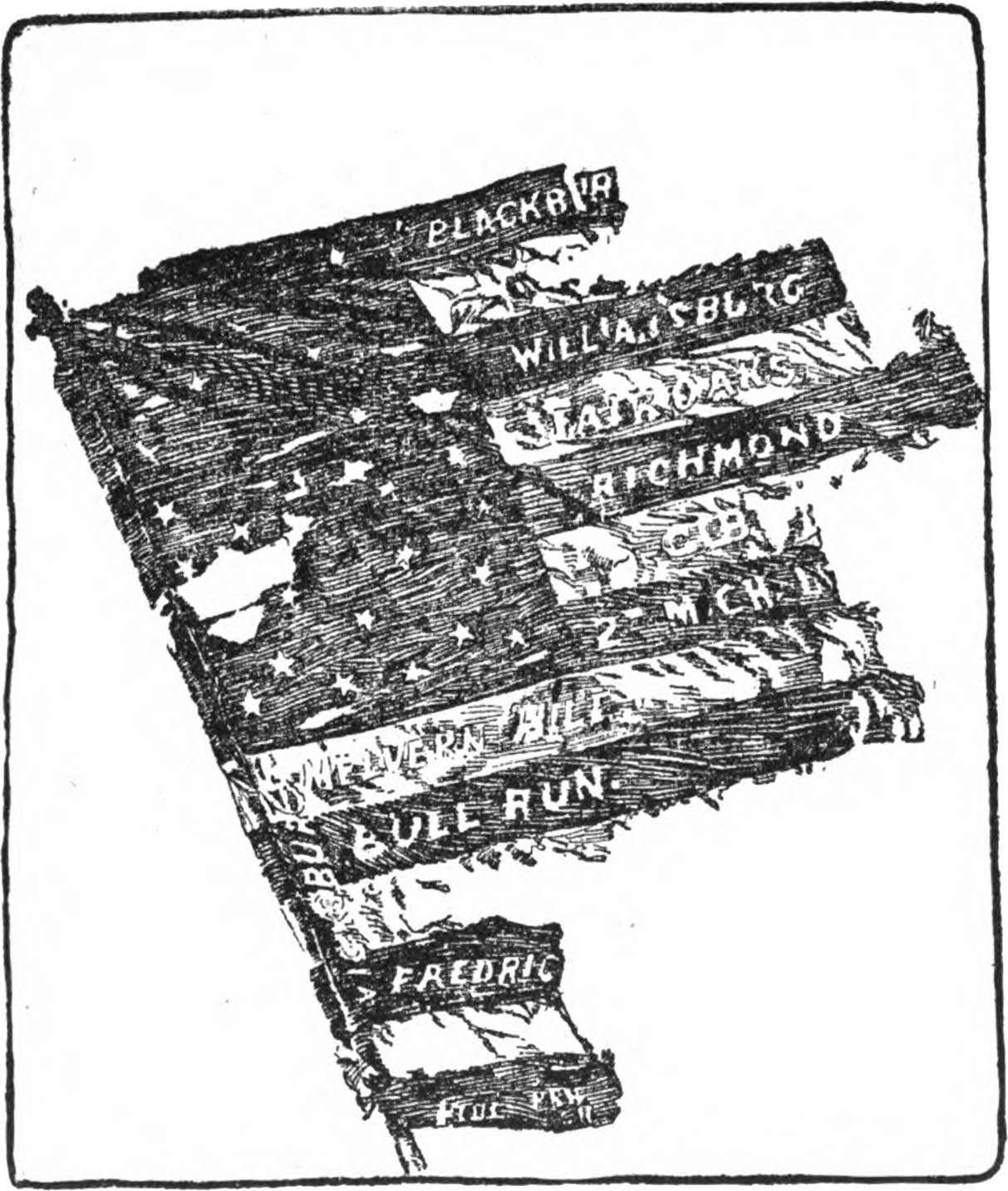
THE OLD FLAG OF THE SECOND MICHIGAN INFANTRY.
During the preliminary organization of the Second Infantry, nearly every company was presented with a flag by the citizens of the locality where it had been recruited; and upon arriving at the rendezvous in Detroit, the Niles company having been designated as the “color company,” the flag brought by them was used as the regimental colors. In February, 1862, this flag, being of very light slik, had become unserviceable. Colonel O. M. Poe, commanding the regiment, obtained from the War Department a set of regulation infantry colors, which he presented, with a stirring speech, to the regiment, and the original flag was returned to its donors. The remnant of this second flag, tattered and battle-scarred, is shown in the above cut, reproduced from an old photograph. It has been carried in thirty-four engagements, and, under its folds, eleven officers and one hundred and ninety-four men have been killed in action, or mortally wounded. On the 24th of November, 1863, at Knoxville, Tenn., the regiment, under command of Major Byington. charged the enemy’s rifle pits. Eighty-four were killed and wounded out of one hundred and fifty engaged, including Major Byington, who was mortally wounded, four officers and the Color Sergeant killed, and six sergeants who lost a leg each, the flag staff being hit three times. July 30th, 1864, during the attack which followed the blowing up of a fort within the enemy’s lines, near Petersburg, Va., known in the list of engagements as “The Crater,” the regiment was in the advance of the charge made by the Ninth Corps. At every step the fire of the enemy in front and on each flank concentrated upon them, and plowed their ranks with great slaughter. The charge was checked on the side of the crest; there was a halt, and finally the whole line of the Brigade, wavering under terrible odds, recoiled; nearly surrounded through lack of proper support, the regimental commander among the dead, fifty-seven men killed and prisoners, and seeing escape hopeless, Color Sergeant Jesse Gaines ran to the rear as far as possible, and cast the flag over the parapet towards our lines, trusting it would be seen and saved by some of our men; he was almost instantly a prisoner, with others of the color guard. The flag was found and taken by the enemy and carried a trophy to Richmond.
A Richmond paper, narrating the events of this desperate battle, said, in substance: “Among the flags taken was that of the Second Mich. Infantry, an organization well known in our army since the first Bull Run battle. It bears the names of many prominent engagements with both the eastern and western armies. This regiment must have been nearly annihilated, or it would never have lost its colors.” And Sergeant Gaines, in his interesting sketch, pithily says: “It is true the flag was lost, but it was never surrendered.” When Richmond was taken it was found in the Rebel capitol, removed to Washington, and later, by an order of the War Department, sent to the regimental association, and is now among the war relics in the capitol at Lansing.
As a proof that no dishonor was attached to the regiment for its loss under such trying circumstances, General Meade, commanding the Army of the Potomac, ordered a new flag to be presented to the regiment, which was done. Upon general orders of Army Headquarters, the following most prominent battles and sieges, in which the regiment had borne a creditable part, were printed upon this last flag, as far as practicable, all minor engagements being left out for want of space on the flag: Blackburn’s Ford, Bull Run, Siege of Yorktown, Williamsburg, Fair Oaks, Glendale, Malvern Hill, Chantilly, Fredericksburg, Siege of Vicksburg, Siege of Jackson, Miss.. Blue Springs, Campbell’s Station. Siege of Knoxville, Wilderness, Spottsylvania, North Anna, Bethesda Church, Cold Harbor, Siege of Petersburg, Crater, Weldon Rail Road, Ream’s Station, Poplar Springs Church, Hatcher’s Run, Fort Steadman, Capture of Petersburg and Appomattox.
Of scenes long passed; mid battle’s strife.
Where it gained a halo of glory.
This dear old Flag, each star and stripe,
Could tell many a touching story.
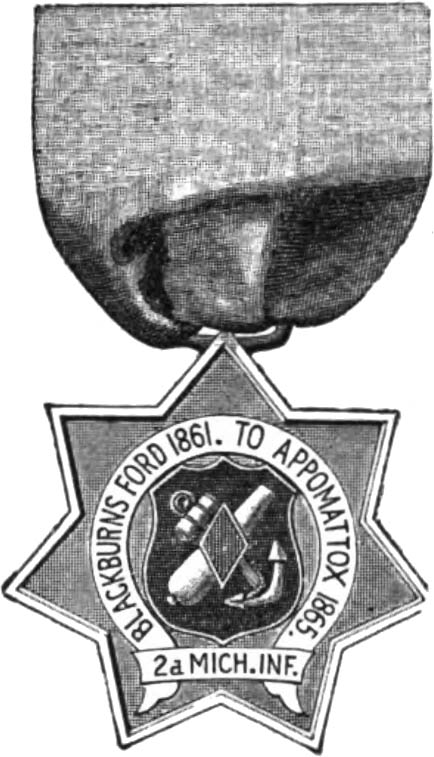
OFFICIAL BADGE OF ASSOCIATION OF SURVIVORS OF SECOND MICH. INFANTRY
At the annual meeting of said Association, at Kalamazoo. October 16, 1888. a committee consisting of Captain John V. Ruehle, Jr., Captain John C. Hardy and Captain William J. Handy, was appointed to report upon a design for a regimental badge, and at the reunion held at Saginaw, August 29, 1889. this committee reported as follows: “A design for a badge has been considered and a sketch Is herewith submitted: Material of badge and bar to be of gold. The cost will be $ ____ the badge to be a seven-pointed star, in general form and dimensions similar to the one adopted by the “Kearney Division Association;” a circle of leaves enclosing the diamond or lozenge of the Third Army Corps in red enamel, the same resting upon the cannon and anchor of the Ninth Army Corps in blue enamel; around the corps badges the words Blackburn’s Ford, 1861, to Appomattox, 1865; below in a scroll ‘2d Mich. Infty’; the badge to be suspended from a bar pin by a red ribbon. The committee also suggests that the issue of badges shall be confined to the following persons only: 1st. To those who were identified with the regiment and served in it during any of the following campaigns, and were honorably discharged from the regiment: The Peninsular Campaign under McClellan, in Virginia under Pope, Virginia under Burnside, Kentucky under Burnside, Mississippi under Grant, Mississippi under Sherman, Tennessee under Burnside or the final campaign against Richmond under Grant. 2nd. To the nearest surviving heir of any member of the regiment who was killed, died of wounds or disease in the service, or died since muster out, (if honorably discharged), the intention being that every member who served creditably with this regiment may hereafter be represented by this badge, and none others.” This report was adopted and the same committee made a permanent one to carry out its provisions. As soon as an application for the badge has been received and approved under the rules adopted by the Association, the badge will be ordered from the manufacturer and forwarded as soon as completed, with the photograph of the old flag.”
[1] At the reunion of the regiment held at Lansing, Oct. 11, 1883, the mysterious disappearance of Frank Thompson was cleared up; and in May, 1900, Col. Schneider published a complete history of Frank Thompson, or Mrs. Seelye, who died at Laporte, Texas, Sept. 5, 1898, and was buried under the auspices of Houston, Texas, Post of the Grand Army of the Republic, of which she had been an honored member.